
Executive Summary
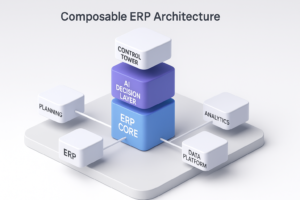
Enterprise Resource Planning (ERP) is not becoming obsolete, but traditional, monolithic ERP alone is no longer enough to remain competitive in today’s dynamic business environment. The relevant solution is, ERP as a stable transaction core complemented by AI-driven decision layers, supply chain control towers, and digital twins within a composable architecture. This combination delivers real-time visibility, faster decisions, and increasingly semi-autonomous operations while preserving compliance and financial integrity.
Enterprises can also be seen as risk-averse, and modernization raises valid concerns about cost, security, and data protection. This article addresses these concerns and provides practical recommendations for those seeking agility without compromising stability while undertaking such transformative initiatives.
Why “ERP-Only” Struggles Today
Legacy ERP excels at financial integrity and compliance, but rapid demand shifts, multi-tier supplier risk, and frequent disruptions demand real-time visibility with proactive planning that core ERP modules alone rarely provide. Additionally, data fragmentation and alert fatigue remain challenges. Even with visibility, organizations can drown in alerts, and one size no longer fits all.
Thus, analysts advocate a composable approach, keep the transactional backbone and plug in best-of-breed planning, logistics, analytics, and AI via APIs. This modularity increases resilience and innovation speed without sacrificing rigor.
The AI-Augmented ERP Landscape
ERP platforms are embedding AI agents and machine learning to automate finance operations, detect anomalies, forecast demand, and optimize inventory. This reduces manual effort and accelerates decision-making.
Control towers help evolve from visibility to action. Modern control towers can integrate ERP, logistics, IoT, and external feeds to provide end-to-end visibility, predictive alerts, and AI driven orchestration, progressing from reactive dashboards to decision automation.
Digital twins simulate supply chain scenarios and validate decisions before execution. Reported benefits include improved forecast accuracy, faster time-to-market, and quality gains when combined with real-time data. Recent research demonstrates that AI can manage inventory and logistics decisions, provided organizations establish guardrails, curate data sharing, and human oversight.
Cost Considerations
Composable architectures add modular systems, AI layers, and integration work which can increase initial costs compared with maintaining a legacy monolith. Cloud models shift spending to ongoing subscriptions, and APIs, middleware, and data harmonization also add initial complexity.
Studies and industry commentary show that if these are implemented via disciplined architecture and governance, benefits will follow. Total cost of ownership declines over 12–18 months due to reduced manual work, lower infrastructure maintenance, and faster innovation cycles.
Security and Data Protection
More components and cloud endpoints increase potential vulnerabilities; therefore, risk assessments and architecture reviews should precede deployments. Sensitive data across regions and providers raises residency and regulatory questions, so alignment to frameworks and proper configuration of controls is essential.
Composable ecosystems involve multiple providers who enforce contractual controls; thus, continuous monitoring and incident response playbooks need to be in place.
Finally, adopt a Zero Trust framework (which enforces strict identity verification and least-privilege access), encrypt data at rest and in transit, implement a shared responsibility model, and use continuous monitoring with AI-driven threat detection. Research emphasizes establishing guardrails and human-in-the-loop oversight for AI-enabled decisions is the way forward.
Building an Enterprise Playbook: Turning Strategy into Action
Modernizing ERP for an AI-driven, agile supply chain is not just a technological upgrade, it is a transformation of how your enterprise operates. Below playbook framework provides a structured approach to move from vision to execution, ensuring every step balances innovation with risk management.
1. Identify and address challenges upfront with clear game plan
· Integration and data quality: Fix master data, metadata, and lineage before layering AI; establish a shared data platform and governance to prevent brittle models
· Alert fatigue and adoption resistance: Advance from visibility to decision automation with human‑in‑the‑loop approvals; measure impact and expand to more workflows.
· Skills and operating model: Create cross‑functional teams (Finance, Supply Chain, IT, Security). Shift to a product mindset and faster release cadence.
· Security and compliance: Embed controls and auditability in every modernization step; conduct threat modeling and tabletop exercises for critical processes.
2. Identify and address production use cases that show immediate benefits
· Automate finance operations: Use AI‑driven automation and anomaly detection to reduce cycle time and errors; reallocate capacity to analysis and planning.
· Enhance demand and inventory planning: Apply AI forecasting and validate decisions against a digital twin before execution; improve service levels and working capital
· Establish a control tower as the command center: Deploy end‑to‑end visibility and predictive alerts, then enable automated responses for routine exceptions under governance; track OTIF, lead time, and cost‑to‑serve.
· Launch a hyper automation program: Combine RPA, AI, and process mining to automate end‑to‑end processes (order‑to‑cash, procure‑to‑pay, logistics exceptions) with auditability; market analyses point to strong productivity and cost improvements.
3. Build and execute a 90-day modernization enterprise blueprint
· Weeks 0–2 | Strategy & guardrails Define ERP core vs. AI overlays; set governance for cost control, data protection, and security. Align with composable principles and risk posture.
· Weeks 3–6 | Enterprise‑grade visibility deployments Deploy a control tower for real time supply chain visibility; implement a digital twin for scenario testing and resilience planning.
· Weeks 7–12 | Embedded AI & automation at scale Automate finance and supply planning workflows in production and begin hyper automation for one end to end process under strict governance.
4. Track progress with key success metrics
These could include, forecast accuracy, OTIF (On-Time In-Full), inventory turns, accounts payable cycle time, exception auto‑resolution rate, working capital improvements, and security compliance scores. By following such a framework, organizations can unlock agility, resilience, and cost efficiency without compromising compliance or stability
Final Thoughts
To modernize ERP for global competitiveness, organizations should adopt a composable architecture by keeping ERP as the transactional backbone while adding modular, intelligent capabilities through APIs. Agility must be balanced with risk management by focusing on enterprise-grade deployments in high-impact areas and scaling methodically to control cost and complexity.
Success depends on investing early in data quality and security, ensuring trusted information and robust controls before enabling autonomy. Finally, build and operate via cross-functional teams spanning Finance, Supply Chain, IT, and Security to sustain and secure innovation at scale.
If you would like to discuss your specific ERP and Supply Chain Transformation journey needs, challenges, and possible solutions, connect with our Quantaleap ERP and AI Advisory team at info@quantaleap.com.