
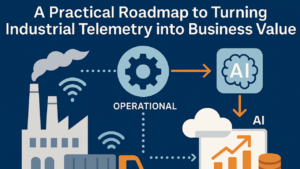
Factories and fleets today generate a staggering amount of telemetry data. Sensors, PLCs, ECUs and gateway devices constant stream data like time-series, logs and status. But the challenge is that this data is messy. It comes in different formats, protocols and doesn’t have proper business context. Since this data is not standardized and connected to IT systems, it remains just “data exhaust”. Once this is connected to the IT systems, the data can be invaluable in driving real outcomes.
At Quantaleap, we believe that industrial telemetry data is one of the most undervalued assets in manufacturing and mobility today. If used right, it can predict failures before they happen, optimize equipment efficiency and save millions in downtime costs.
Why this matters: The business value
McKinsey’s research states that manufacturing and mobility settings capture one of the largest shares of IoT value. But most of that value goes unrealized because companies stop after implementing PoCs or deploy only point solutions that don’t scale with the requirement. Once you have integrated and industrialized telemetry, you achieve governance, repeatability and traceability of IoT data. This helps enterprises unlock benefits like:
- Reduced downtime through predictive maintenance
- Higher asset utilization via OEE analysis and optimization
- Lower operational costs from smart inventory and supply chain planning
- Safer operations through anomaly detection and just-in-time correction
This is not just about shiny dashboards. It is about creating measurable business outcomes that move the needle on business value realization using industrial data.
The challenge: Machines speak different languages
As we already saw, different machine, equipment and electronic elements have different protocols and therefore the data needs to be standardized and then converted to a cloud readable format for io integrate and consume with IT Systems.
- Your PLCs and industrial sensors might speak Modbus, PROFINET or OPC UA.
- Your vehicles may send data over CAN bus, OBD-II, or proprietary formats.
- But your cloud IoT platforms — AWS IoT, Azure IoT Hub, Kafka streams — want clean JSON over MQTT or HTTPS.
It is like having a room full of people speaking English, Mandarin and Spanish and you need them to collaborate on the same project. Unless you translate first, it’s chaos. That’s where protocol conversion at the edge comes in, turning all those different “dialects” into one common language.
From raw signals to business insights: the pipeline journey
Quantaleap provides a practical roadmap for anyone looking to industrialize their telemetry data.

- Protocol Conversion at the Edge Translate Modbus, CAN, OPC UA or binary dumps into MQTT/HTTPS streams. Add schema mapping and metadata so the data makes sense later.
- Automated Mapping Different devices produce different tags, units and formats. Instead of manually adding the device data every time a new device comes online, we recommend a metadata-driven mapping engine that automates onboarding.
- Landing in a Datalake Store everything raw payloads, canonicalized formats and time-series tables, in a governed datalake. This becomes the single source of truth.
- Enrichment with Business Context Telemetry alone is just numbers. The magic happens when you combine it with ERP/MES data like BOMs, maintenance logs, work orders. Suddenly, you’re not just looking at “temperature = 95°C” but “temperature = 95°C on Asset X during Shift 2, right before a maintenance event.”
- Data Warehouse & Feature Stores Curated data goes into a data warehouse for Analytics and into feature stores for ML. That way, plant managers get dashboards and data scientists get training-ready datasets.
- Visualization & BI Dashboards for operators. Self-service analytics for executives. Real-time alerts for engineers. The key is tailoring insights to different roles.
- Industrial AI/ML With clean, contextualized data, you can finally deploy predictive maintenance models, anomaly detectors and even digital twins. But to do this at scale, you need solid MLOps practices like version control, model monitoring, drift detection, retraining.
Each step isn’t just technical plumbing. It is a part of a bigger story of how to move from raw machine chatter to actionable business intelligence.
How Quantaleap can help
We work with customers to design and implement end-to-end telemetry pipelines that are production-ready from day one.
Our approach usually looks like this:
- Discovery (2 weeks) – Inventory devices, analyze data rates, map desired outcomes.
- Proof of Concept (4–6 weeks) – Deploy an edge adapter, set up a landing datalake, build one curated table, one dashboard and run a small ML experiment (say, anomaly detection on a pump or fleet vehicle).
- Scale & Harden (9 weeks) – Add governance, lineage, MLOps and roll out enterprise-grade BI.
We don’t just install tools; we build frameworks that last.
Closing thought
Building a telemetry pipeline isn’t just a data engineering exercise. It’s an engineering discipline that combines operational technology, cloud architecture and applied AI. Done right, it transforms how factories and fleets operate. And the best part is that the building blocks are here today. It is not futuristic. It is practical and already delivering value in production systems.
If you are curious to learn more via a detailed technical playbook, including architectures, tools and tradeoffs, reach out for a 30‑minute discovery call at, info@quantaleap.com.